
eRank does NOT provide tax, legal, or accounting advice. This material has been prepared solely for informational purposes. It is not intended to provide, and should not be relied on for, tax, legal, or accounting advice. You should consult your own tax, legal, and accounting advisors.
Boring as it may be, accounting will always be part of being a small business owner. Accounting is tracking your finances: what you are paid and what you spend. Etsy sellers need to understand accounting terms like revenue, expenses, and net profit. When you set business goals and track your progress, it’s important to understand what each of these terms means.
This guide has the most common accounting and bookkeeping terms you’ll see on Etsy. Some calculations and definitions may differ slightly depending on your country, so check with your local government or tax professional if you need more clarification.
Etsy Accounting Terms on the “Payment Account” and “Shop Stats” Pages
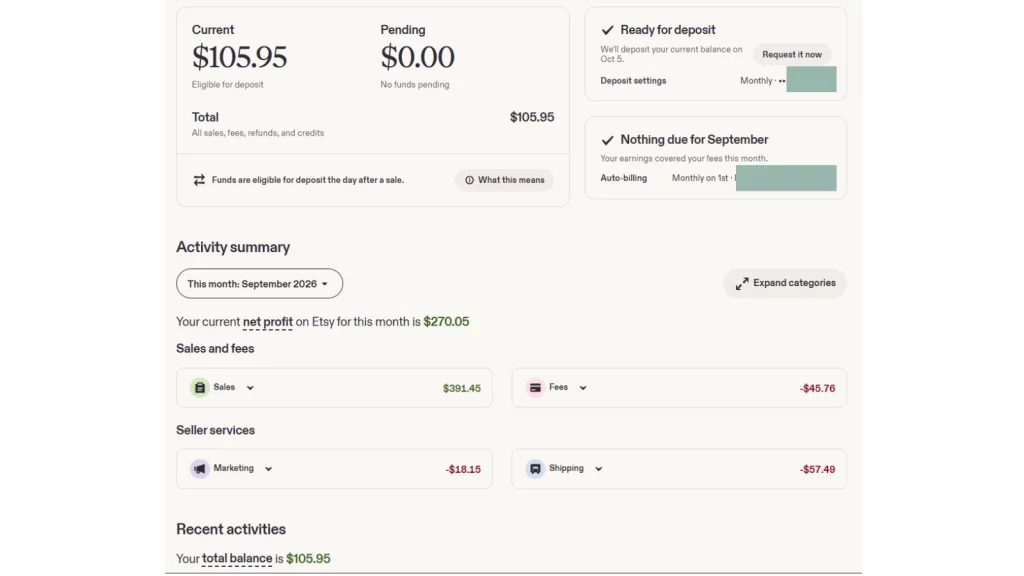
On your Etsy Shop Manager dashboard, click “Finances,” then “Payment account.” This takes you to an overview of your shop’s current finances. Here are some basic definitions for the accounting terms on this page:
- Current: The amount of money eligible for deposit. These are customers’ payments that have cleared and are sitting in your Etsy account. Etsy fees and shipping label payments are deducted from here.
- Pending: Funds Etsy is withholding. Etsy marks funds as “Pending” when it’s waiting for a buyer’s payment to clear. Funds are also marked as such when Etsy places a payment reserve on your account.
- Net Profit: Your total sales on Etsy minus refunds, fees, marketing, and shipping costs. Learn how to calculate your Etsy shop’s profit margin.
- Total Balance: A running total of all activity in your payment account.
- Sales: The total funds from all of your shop’s sales.
- Fees: Listing, transaction, and processing fees. This area also includes credits for programs like Etsy Plus and Share & Save.
- Marketing: Etsy Ads, Offsite Ads, and sales tax you’ve paid on Etsy’s subscription services like Etsy Plus and Pattern.
Revenue: Your sales minus any discounts you provided to customers. The “Shop Stats” page doesn’t factor in selling fees, shipping costs, or orders that you have fully refunded and canceled.
Other Basic Bookkeeping and Accounting Terms To Know
Your Etsy payment account page gives you a broad overview of your day-to-day finances. In addition to the words we just discussed, it’s important to know what the following terms mean, especially when filling out tax documents. Some accounting software for Etsy sellers, such as QuickBooks Self-Employed, can file for you. However, you still need to provide the numbers!
- Income: The amount of money that you received from customers.
- Gross Sales: The total amount your buyers paid you, before subtracting expenses.
- Expense: The amount that you paid to operate your business (this figure includes things like subscription fees, marketing fees, and supply costs).
- Inventory: All of the products in your shop that you ship to customers. This also includes the individual parts that make up the item that you are selling.
- Supplies: Items you use to create, package, or ship your products, but are not part of the final product you sell. These are, for the most part, tangible goods like tools, packaging materials, shipping labels, and printer ink.
- Cost of Goods Sold (COGS): The amount of money spent in order to produce and ship an item. This can include raw materials, labor, and packing supplies.
Where To Learn More About Accounting Terms
Running a successful Etsy business includes accurate bookkeeping and staying on top of your accounts. Knowing where your money goes and how much you bring home is key to setting business goals and staying tax compliant. While this post contains some of the most common accounting terms, it is not an exhaustive list.
For SEO and other Etsy-related terms, check out the eRank University Glossary.
If you’re a US seller, the IRS has a large glossary with more in-depth terms that cover a wide variety of forms, not just those for small businesses.
Links to Various Tax Agencies: