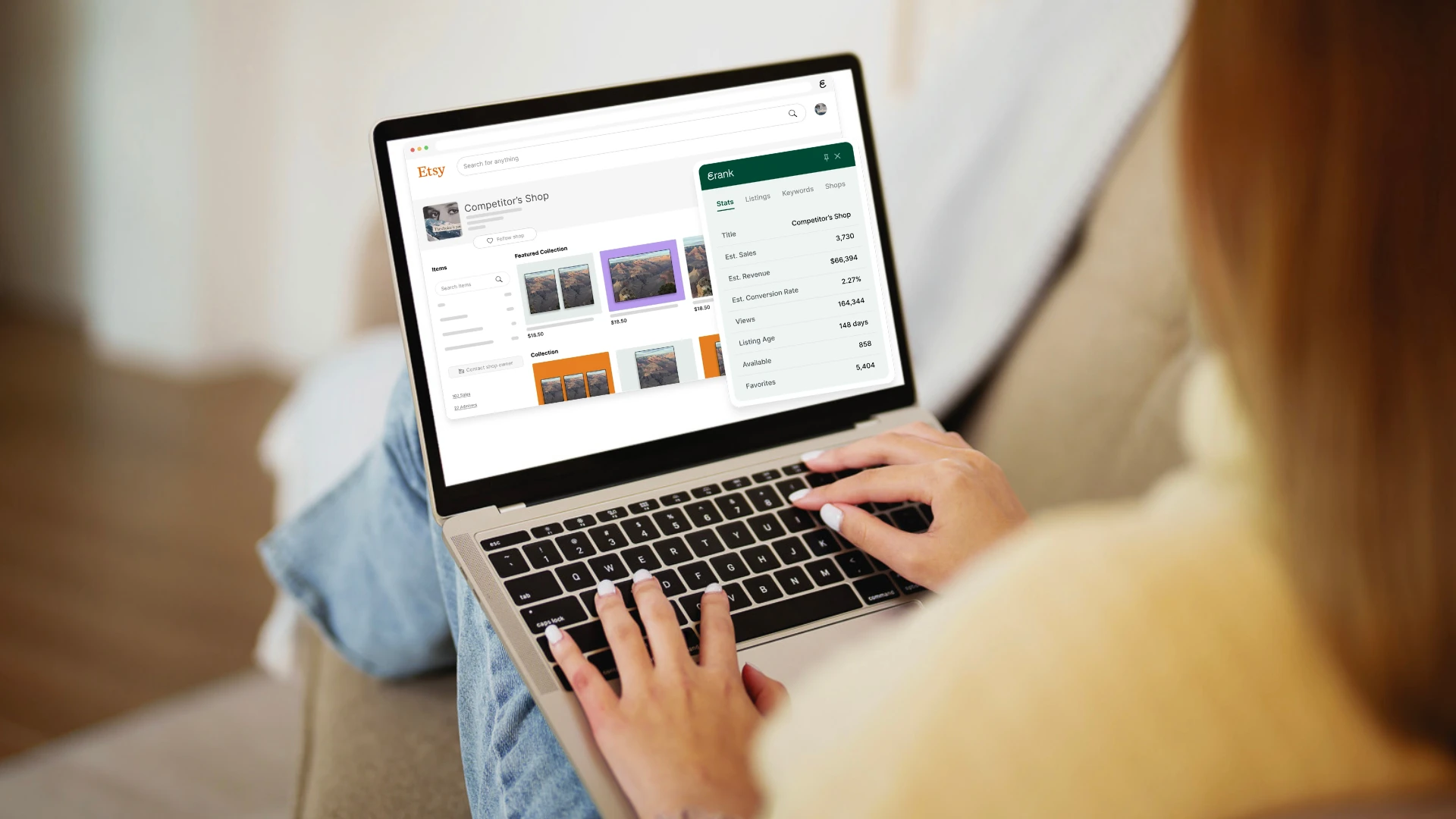
Etsy Seller Fees Explained
Before you begin to sell on Etsy, it’s important to understand Etsy seller fees and how they affect your shop’s bottom line. Why? Fees are operating costs, which you need to take into account when pricing your items. Don’t let fees eat into your profit margins and leave you wondering where your money went. Let’s break down Etsy’s standard selling fee structure, additional fees you may encounter on this platform, and how these all compare to the fees required to own your own website or a “brick-and-mortar” store.
Etsy Shop Set-Up Fee
During the shop creation process, Etsy charges a one-time set-up fee. Once the platform has processed your payment, shoppers will be able to purchase your items. Etsy charges this fee to verify your banking information. This charge is non-refundable. So, before officially opening up your Etsy business, make sure that it’s something into which you truly don’t mind investing your time, money, and hard work. For a more in-depth look at this fee, read the eRank blog post Understanding Etsy’s Setup Fee.
Before Making a Sale
Listing Fees
When you add a product to your Etsy shop, you are creating a listing. Listing fees are what you pay to list products for sale on Etsy. Etsy charges a listing fee of $0.20 USD for each individual listing you activate. This fee applies to both physical items and digital downloads. Since it is the fee for listing an item, each listing incurs this fee whether or not the item sells. Each charge of $0.20 USD keeps that listing active for four months. What happens at the end of those four months, and what happens if your item sells sooner, is covered in the “Renewal Fee” section below.
There are two listing fee exceptions:
- When you create a private listing for a customer, you will only owe a listing fee if it sells.
- Etsy Pattern sellers do not pay these fees for listings available only on their Pattern site.
Renewal Fee
Every listing stays active for four months. When those four months are up, Etsy automatically charges a $0.20 USD renewal fee to keep it live. If you have turned off automatic renewal, however, your listing will expire and deactivate at the end of those four months.
To manage this setting:
- In your Shop Manager, select “Listings” from the left side panel.
- Click the gear icon in the bottom right corner of the listing you’d like to edit.
- Select “Edit” from the pop-up menu. This will open your listing editor.
- Scroll down to “Renewal options” at the bottom of the page.
- Select either “Automatic” (so that the listing will automatically renew each time it expires) or “Manual” (so that you can choose to either renew it yourself or let it deactivate).
You can also update this setting for multiple listings at once via the “Listings” page, so you don’t have to edit each listing one by one.
One thing to keep in mind: if your item sells before the four months are up, Etsy will charge you the $0.20 fee immediately after the sale. This is because the platform charges $0.20 to “renew” the listing as soon as a unit is sold, regardless of how much time is left. Each time this fee is charged, the four-month countdown resets. For everything you need to know about how this works after a sale, see the “Per-Unit Renewal Fee” section below.
After Making a Sale
Once that cha-ching comes in, Etsy will charge you several additional fees. However, these fees come out of what the buyer paid you.
Per-Unit Renewal Fee
As mentioned above, every time a unit sells, Etsy charges a $0.20 USD renewal fee to keep the listing active. This applies regardless of how much time is left in the four-month period.
Here’s a tricky bit that many miss: this fee applies per unit sold, not per order. So, if a buyer purchases three units of the same item in a single order, Etsy charges $0.60 USD in renewal fees. Should your item sell out completely, you will need to pay another $0.20 USD to reactivate the listing.
Transaction Fee
Excluding any applicable sales taxes, the Etsy transaction fee is 6.5% of your item’s price, plus shipping and gift-wrapping. It’s important to remember that this fee applies to shipping and gift wrapping. So, if you use Etsy labels with calculated shipping, consider a minor increase to your listings’ prices to cover that fee.
Payment Processing Fee
Etsy payment processing fees are a percentage of the total order amount plus a flat fee per order. In the US, it is 3% + $0.25 USD per order.
The fee amount depends on the country in which your bank account is located. To find out how much Etsy payment fees are in your country, check out this section in Etsy’s “Our House Rules” article regarding Etsy Payments Policy.
Country-Specific Miscellaneous Fees
Depending on the country you are in, you may have to pay additional fees as an Etsy seller. These include (but are not limited to) deposit fees, VAT, regulatory operating fees, and currency conversion fees. You can find more information regarding these here.
Example Sales with Etsy Fee Calculation
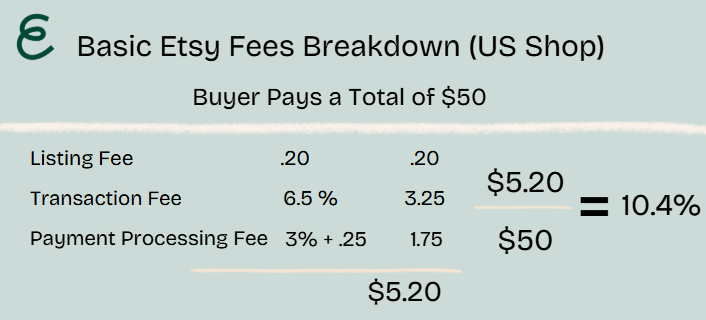
In the following example, a buyer in the US paid a total of $50 (including shipping). After factoring in seller fees, the amount Etsy takes from the transaction comes to 10.4% of the sale price.
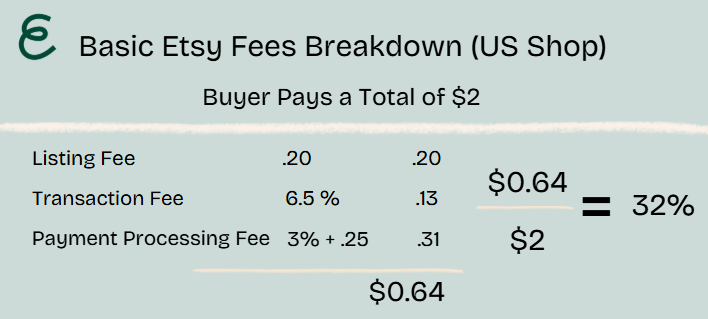
To show how drastically that percentage can change for low-margin items, here is a breakdown of the fees for a $2 sale. Since the price point is so low, the percentage of Etsy fees is much higher than it was with the $50 order.
You can watch a demonstration of this breakdown (and a few other examples) in this video and this video.
Etsy Ads and Offsite Ads Fees
Etsy offers two types of paid advertising to sellers. Etsy Ads are the ads that appear on Etsy in shoppers’ search results. These are voluntary and have no additional fees once a sale is made; you simply pay the cost per click each time a shopper clicks your ad. For more information on Etsy Ads, read this help page.
Offsite Ads are ads that appear on platforms Etsy has partnered with, such as Google and Instagram. After a shopper clicks your offsite ad, Etsy adds a fee to any sale in your shop initiated by that customer for the next 30 days. These fees are deducted from your balance on the day of the sale.
If your shop makes less than $10,000 USD per 12-month period, Etsy charges a 15% Offsite Ads fee per order. As long as your shop stays under the $10,000/12-month period threshold, you are free to opt in or opt out of Offsite Ads. Once your shop has made more than $10,000 in any 12-month period, you cannot opt out of Offsite Ads. However, once your shop reaches this threshold, please note that the Offsite Ads fee will decrease to 12%.
Do you sell high-ticket and/or luxury goods? Good news: Offsite Ads fees never exceed $100 per order. This threshold applies regardless of the order’s total revenue. For more information on Offsite Ads fees, click here.
Square In-Person Selling Fees
Did you know you can sell your items listed on Etsy in person using a Square reader? This is a convenient way to sell your items at in-person events or to family and friends.
Want to sync your listings with Square? If so, you will be charged the same $0.20 renewal fee per sold listing that you accrue with online orders. If you choose not to sync your listings, each sold listing will also accrue a $0.20 transaction fee. This will be displayed as a “Square manual” fee in the “Activity Summary” section or in your Etsy payment account. Sales processed via Square are not subject to Etsy’s 6.5% transaction fee or payment processing fees. However, they will be subject to Square’s payment processing fees.
Having a Physical Location
If you have a successful Etsy shop and are looking to open a “brick-and-mortar” storefront, it’s very important to think about the costs associated with owning a physical location in your area. Not only will you need to pay rent, but you’ll also need to pay for utilities, marketing, insurance, licenses, and other expenses that are specific to your niche. It’s crucial to take all of these factors into consideration when pricing your items. Start a spreadsheet and see how your profit margins change when making adjustments based on those other costs.
Other Marketplaces To Consider
If you’re concerned with the amount of fees required to sell on Etsy, consider researching other platforms and web-hosting sites, such as eBay, Shopify, Wix, and WordPress. Each of these comes with its own monthly fees and/or processing fees. However, the different levels of customization available on them could make one or more of these options better for your business. During your research, remember to ensure that your profit margins still align with your business strategy.
Calculate Your Etsy Fees With eRank
Factoring an online marketplace’s selling fees into the prices of your goods can be confusing. Even so, knowing the cost of doing business on your platform of choice is important if you want to maintain adequate profit margins.
You can use eRank’s Profit Calculator to calculate the estimated cost of creating and selling your items on Etsy. Don’t forget to include packaging, marketing, and labor costs. When pricing, start by establishing your profit margin. This makes it easy to arrive at a product price that’s fair for both you and your customers.
Our team is continuously improving eRank’s tools to better serve our members. Due to this, some of the content featured in this post may differ from the content featured on erank.com.